
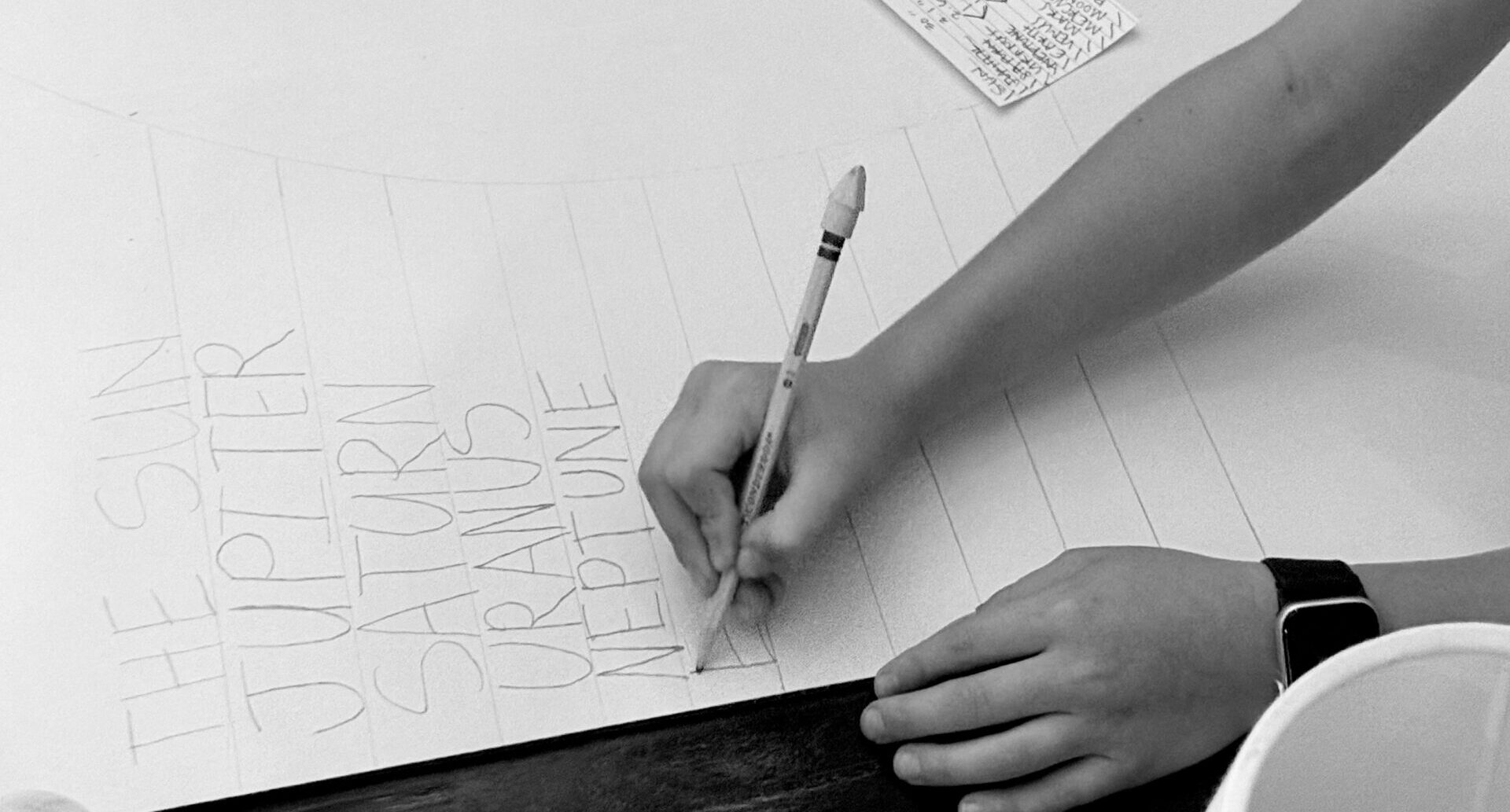
My son wanted to fill the white space.
The fifth graders were tasked with identifying and solving a visual communications problem with representing the Solar System. His first idea was a three-dimensional model that would demonstrate the difference in size between the Sun, Planets and Moon, until we did the math. If the planets were to scale, the Sun would dwarf almost everything else. Earth would be tiny. Pluto would be almost imperceptible.
So, we changed the plan. We decided to draw the Sun as a 30″ circle by placing a thumbtack in the dead center of the board with a 15” length of string attached to a pencil as our compass. From the same center point, within the volume of the sun, we drew concentric circles representing the other bodies by diameter.
Jupiter and Saturn appeared first, the largest was a measly 1/10 the size of the sun. Uranus and Neptune were considerably smaller. From there, the terrestrial planets collapsed into a cluster of almost comically tiny rings at the center. And suddenly we had a lot of blank poster board.
My ten-year-old looked at it and did what ten-year-olds do with empty space. He wanted to put something in it. Color. Stars. Drawings. Something.
“But that’s the whole point,” I told him. The white space was the model.
Somewhere between explaining this concept to him and looking at this enormous field of untouched poster board, I realized I’ve spent much of my life studying white space – when to fill it, when to leave it – while being remarkably bad at leaving any in my own life.
I first learned about negative space as an architecture student. Space is not what remains after you design the building. It is part of the building and part of the process itself.
Later, as an interior designer, I learned it again. A beautiful object needs room around it. Art needs a wall on which it can breathe. The best rooms aren’t the ones containing the most things. They’re the ones where you can tell what matters. As an artist, this principle becomes even more obvious.
A mark has power because of the surface and space surrounding it.
One day, somehow, I became a legal technologist in an industry where our ability to fill space is limitless. More applications. More data. More dashboards. More notifications. More meetings. More AI. More words. More information competing for the same finite amount of human attention.
The difficult work is rarely figuring out what else we can add; it’s deciding what deserves to remain.
And then there is motherhood. This may be the place where I struggle to the most to tolerate white space. There is always something that can occupy an open hour. A school event. A committee. A work obligation. A sports practice. A birthday. A dinner. A trip. A house project. An email. A volunteer role. Someone who needs something.
For years, I have interpreted capacity as obligation. If I can do something, I should. If I have a skill that is useful, I should offer it. If there is an open space on the calendar, it is time to make plans.
There’s generosity in that instinct. Ambition, too. Curiosity. Energy. A desire to participate fully in your own life. But abundance without editing eventually becomes clutter.
I know that when I’m designing a room.
I know it when I’m designing a system.
I know it when I’m making art.
I’m only beginning to understand it in the design of life.
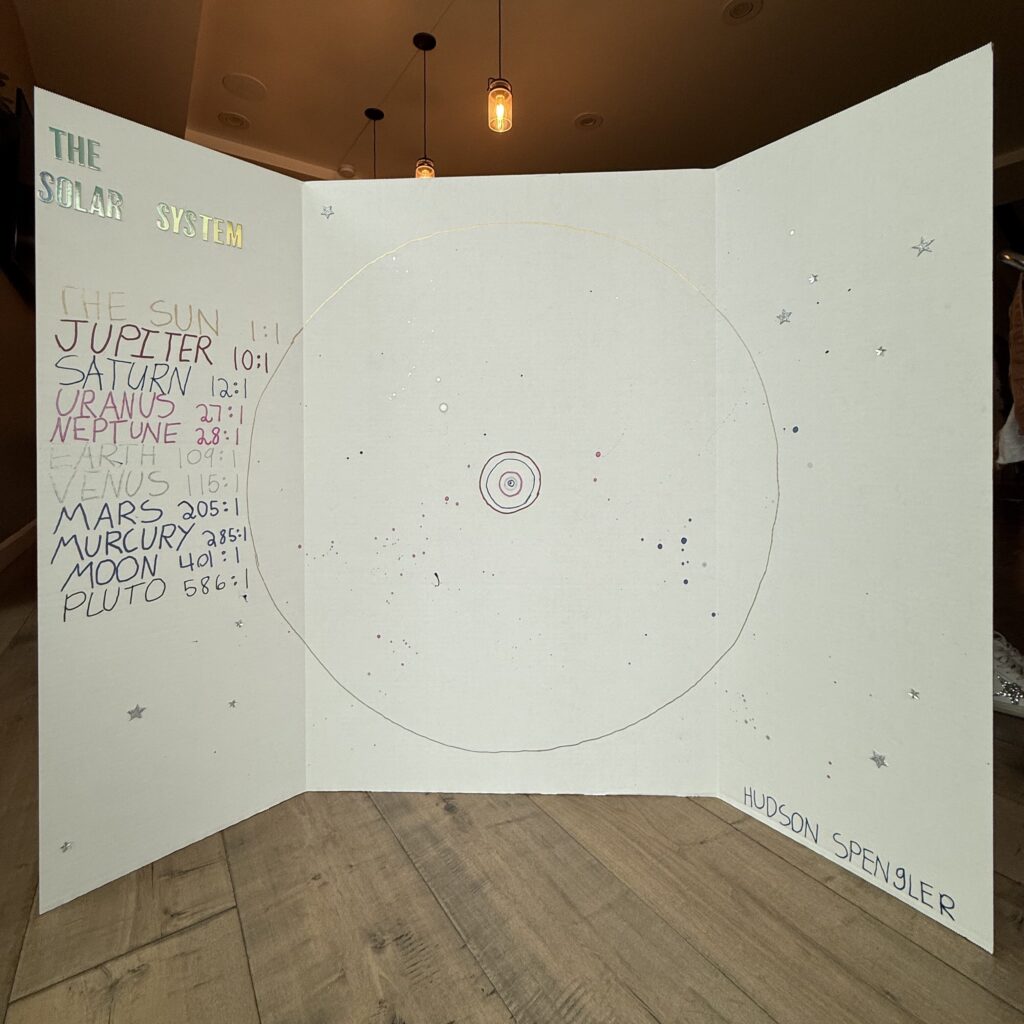
I keep thinking about that enormous piece of white poster board. The slender rings elegantly occupied only a fraction of the space. At first, the emptiness looked like something we had failed to finish; something that would appear to be the result of laziness. But the longer I looked at it, the more I understood that the empty part was carrying most of the meaning. And I wonder how many things in my own life I have mistaken for unfinished simply because they were unfilled.
An afternoon.
A wall.
A calendar.
A season.
A part of myself that didn’t yet have a project attached to it.
My son wanted to know what we should put in the white space. For perhaps the first time in a long time, my answer was: nothing.
And nothing turned out to be exactly what it needed.
Leave a Reply